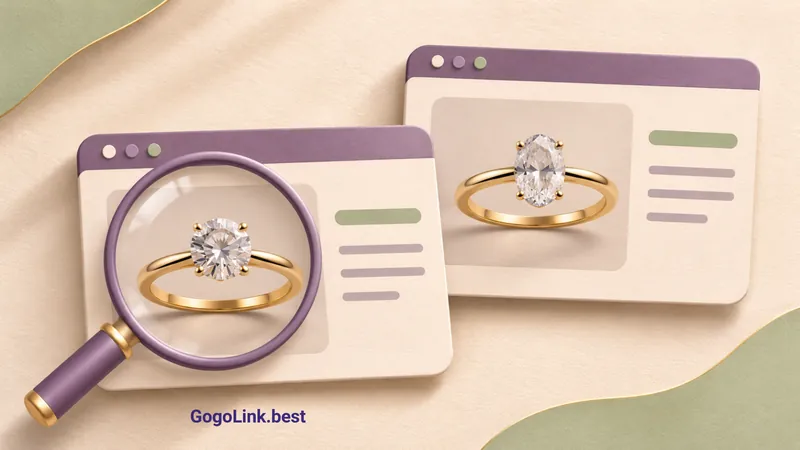
To compare engagement rings online, look behind the price: stone type, centre-diamond weight, ring construction and purchase terms. A few focused checks help narrow your options and leave fewer questions unanswered.
Two rings appear side by side on your screen. Both have a bright stone, a thin band and a description promising an impressive look. Their prices differ, but the photos do little to explain why. Before deciding the expensive ring is better or the cheaper one a bargain, check whether you are comparing the same kind of product at all.
A useful starting point is to choose two or three models and collect the same details for each. Every missing detail then becomes a clear question for the seller, rather than another reason to open a tab.
Start with your budget and style
Set a budget for the whole purchase and check which extra costs might apply, such as resizing, engraving or delivery. Then choose a design direction. Metal colour, stone shape and a preference for a plain or stone-set band will help narrow the search.
Look at the jewellery the person receiving the ring already enjoys wearing. If you are unsure of their taste, you can discuss styles without revealing when you plan to propose. This is a choice they will live with long after the occasion itself.
You could start with the engagement rings (Opens in a new tab) category on Zaban's website, save a few models that suit your chosen direction and open each one's specifications. The category page helps you find candidates; the comparison starts with the individual model details.
If the results are still too broad, try adding one feature to your search, such as the stone shape or gold colour. GogoLink's guide to more precise Google searches offers other ways to focus your question.
Does the carat figure cover the centre stone or all the stones?
This is worth clarifying early. According to the Gemological Institute of America, GIA, the weight of one stone and the combined diamond weight in a ring are different figures. Total weight adds together all the diamonds set in the piece, including the small stones around the centre diamond.
For example, a ring with a 0.60-carat centre diamond and additional stones weighing 0.40 carats in total contains one carat of diamonds altogether. That does not make its centre diamond a one-carat stone. This is an arithmetic example, not the specification of a particular model.
Equal weight does not guarantee that stones will look the same size either. GIA's guide to diamond carat weight (Opens in a new tab) explains that cutting also affects visible dimensions. Ask for the stone's measurements in millimetres, and keep centre-stone weight and total weight separate in your notes.
Clear specifications help explain price differences
For each model, record the stone type: a natural diamond, a laboratory-grown diamond or another kind of stone. Leave space for the metal type and its stated purity too. Do not assume two similar-looking rings use the same materials.
GIA describes diamonds using four familiar characteristics: carat weight, colour, clarity and cut quality. If a seller provides these details, check which stone they refer to and whether they describe the stone on offer or a possible range.
If the specifications are incomplete, ask a short question: what is the centre stone's weight and type, and what grading information comes with it? A written answer lets you return to your comparison without relying on your memory of a phone call. It also shows which differences between models are established and which remain unclear.
Photos help you choose a design. Check the fit separately
Ask to see the ring from the side as well as from above. This helps you understand the setting's height and the band's construction. If it will be worn beside a wedding band, find out how the two rings sit together.
You can request a short video or a photograph of the ring on a hand, and ask whether the pictures show the actual item or an illustrative model. Where a fitting is possible, use it to check comfort and size. If you are ordering as a surprise, ask in advance how later resizing works.
Treat photography as one stage of narrowing your choice. It helps identify a design you like, while dimensions, materials and how the ring feels on the hand need separate answers.
Check which document is supplied and which stone it covers
The word certificate alone does not tell you who examined the stone or what was checked. Ask who issued the document, what details it contains and whether it covers the centre diamond, several stones or the piece of jewellery.
In its online diamond-buying guidance, GIA recommends checking an independent grading report. If a GIA report is shown, you can compare its details with the institute's Report Check record. The online check confirms a match with the record; identifying the physical stone and matching it to the document requires a separate check.
Do not infer from a category-page heading which report will accompany every model. Request the details for the ring you have chosen.
Before paying, resolve the remaining questions
Finally, make sure the order fits your plans too. Record the agreed delivery date, the size and the services included in the price. If you plan to propose on a particular date, tell the seller and request a defined delivery date.
Ask what the warranty covers, how resizing is handled, and which exchange or return terms apply to your chosen item. If you plan engraving or customization, ask in advance how it affects those terms. Keep the model details and the answers alongside your order confirmation.
Before closing the browser, write one sentence beside your choice: we chose this ring for its design, specifications and fit with our budget. If you cannot finish that sentence without relying only on the picture or the discount, return to the detail that is still missing.